The Story of Borobudur: Indonesia’s Timeless Legacy That Continues to Inspire the World
The Story of Borobudur: Indonesia’s Timeless Legacy That Continues to Inspire the World
MuhammadAriLaw News | MAGELANG, Central Java, Indonesia | Tuesday, July 28, 2026 | 10:00 WIB
MAGELANG, Indonesia — Rising above the lush Kedu Plain of Central Java, surrounded by volcanic mountains and fertile landscapes, Borobudur stands as one of humanity’s greatest architectural and cultural achievements. More than a Buddhist monument, it represents Indonesia’s enduring contribution to world civilization—a masterpiece where history, spirituality, engineering, and art converge.
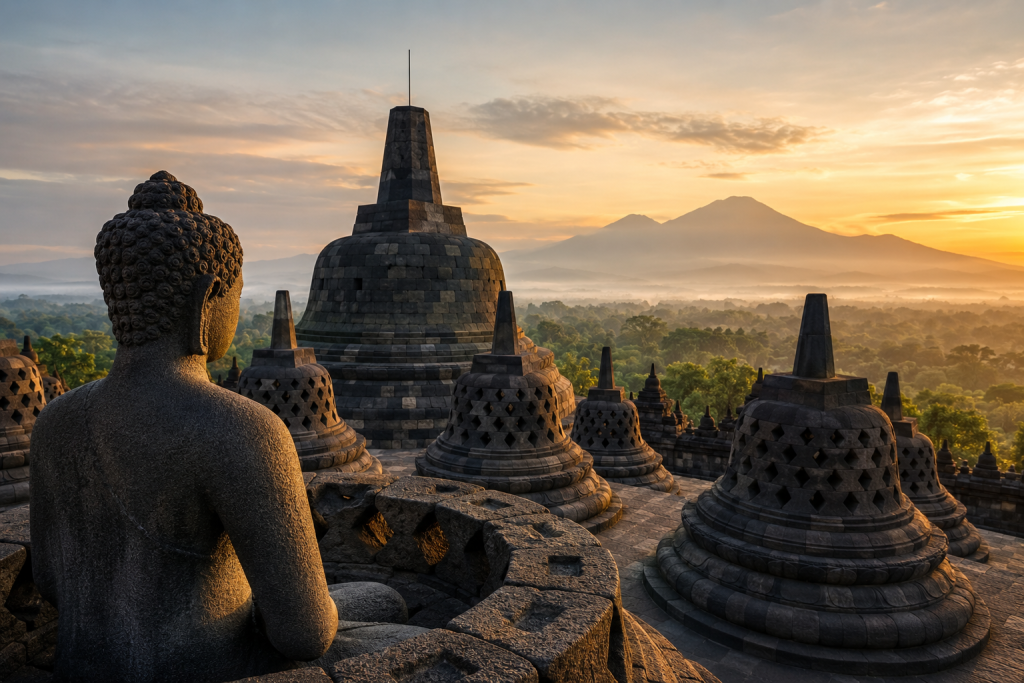
Constructed during the 8th and 9th centuries under the reign of the Syailendra Dynasty, Borobudur is widely recognized as the largest Buddhist temple in the world. Built from an estimated two million volcanic stone blocks, the monument was assembled without modern cement or steel reinforcement, relying instead on sophisticated interlocking techniques that have allowed it to survive for more than 1,200 years.
Its remarkable design reflects a profound understanding of architecture, astronomy, geometry, and Buddhist philosophy. Viewed from above, Borobudur forms a giant mandala, symbolizing the spiritual journey from the earthly realm toward enlightenment.
The monument consists of nine stacked terraces—six square platforms followed by three circular ones—culminating in a magnificent central stupa. Surrounding it are 72 perforated stupas containing seated Buddha statues, while more than 2,600 relief panels and 500 Buddha sculptures narrate stories of morality, compassion, wisdom, and everyday life in ancient Java.
Historians consider Borobudur not merely a religious monument but also an extraordinary historical archive carved in stone. Its reliefs document maritime trade, agriculture, traditional clothing, architecture, musical instruments, and the thriving civilization that once flourished across the Indonesian archipelago and the wider Asian region.
For centuries, Borobudur disappeared beneath layers of volcanic ash and dense tropical vegetation following eruptions from nearby Mount Merapi and shifting political centers. Hidden from public view, the monument remained largely forgotten until 1814, when British Governor Sir Thomas Stamford Raffles ordered its rediscovery during the British administration of Java.
The discovery marked the beginning of one of the world’s most significant archaeological preservation efforts. Between 1975 and 1982, the Government of Indonesia and UNESCO carried out a comprehensive international restoration project involving experts from numerous countries. Millions of stone blocks were dismantled, cleaned, reinforced, and carefully reassembled to preserve the monument for future generations.
In 1991, UNESCO officially inscribed Borobudur on the World Heritage List, recognizing its Outstanding Universal Value and its exceptional testimony to human creativity and cultural achievement.
Today, Borobudur welcomes visitors, researchers, historians, archaeologists, photographers, and Buddhist pilgrims from around the world. It has become one of Southeast Asia’s most important cultural destinations, attracting international visitors who seek not only its architectural grandeur but also the timeless philosophical messages engraved into its stone walls.
Beyond tourism, Borobudur represents Indonesia’s cultural diplomacy on the global stage. The monument demonstrates that the Indonesian archipelago has long been a crossroads of civilization, where religion, science, art, and commerce developed in harmony centuries before the modern era.
Cultural experts emphasize that preserving Borobudur extends far beyond protecting an ancient structure. It means safeguarding humanity’s shared heritage and ensuring that future generations continue to learn from one of the greatest monuments ever built.
As the world faces rapid technological change and cultural transformation, Borobudur remains a powerful reminder that the achievements of civilization are measured not only by economic progress but also by the wisdom, creativity, and values passed from one generation to the next.
More than twelve centuries after its construction, Borobudur continues to stand in quiet dignity over the Indonesian landscape—an enduring symbol of peace, knowledge, tolerance, and human ingenuity.
For Indonesia, Borobudur is more than a national treasure.
For the world, it is a legacy that belongs to all humanity.
Reporting by MuhammadAriLaw News
Filed from Magelang, Central Java, Indonesia
Published: Tuesday, July 28, 2026 | 10:00 WIB